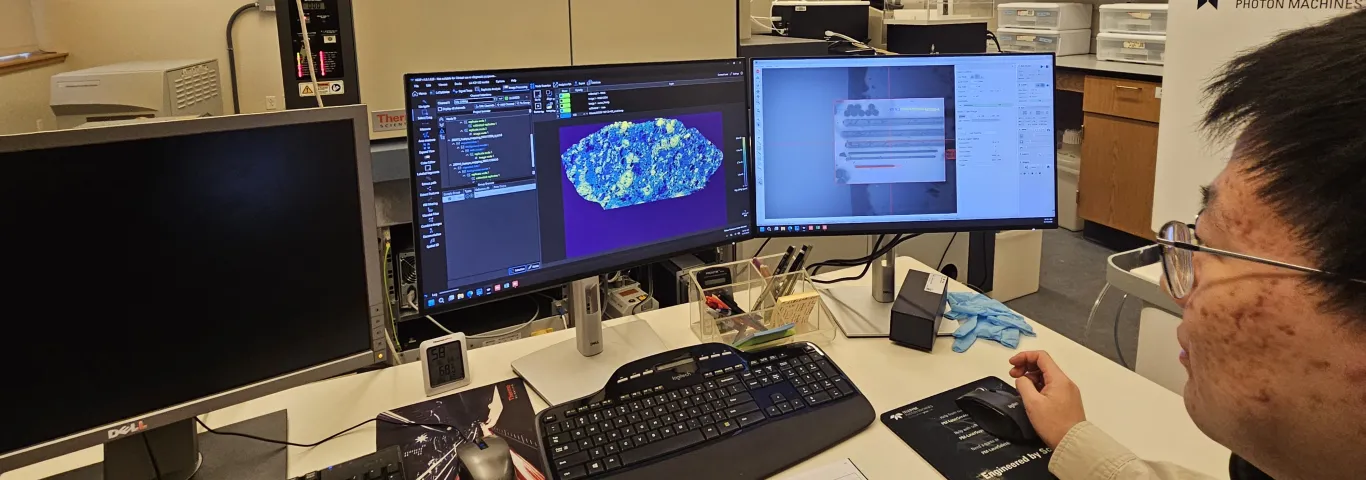

Installed in February through the generosity of Jerrold and Marsha Grossman with additional Major Equipment funds from the McDonnell Center for the Space Sciences (MCSS), the Teledyne Photon Machines IRIDIA femtosecond laser ablation system represents a major step forward in analytical capability. According to Kun Wang, associate professor of Earth, environmental, and planetary sciences and an MCSS fellow, this instrument is the first femtosecond laser developed by Teledyne. WashU is serving as its demonstration site in the United States.
A femtosecond is one quadrillionth of a second. At this timescale, the laser delivers energy in extremely short bursts, removing material before heat can spread into the surrounding sample.
Only two companies worldwide currently manufacture femtosecond lasers of this type. Having one on campus places WashU alongside institutions such as MIT and Caltech at the forefront of high-precision geochemical analysis.
Seeing More by Preserving More
Traditional methods for analyzing planetary materials often require dissolving samples in solution. This process is time-consuming and destructive. Once dissolved, the original structure of the sample is lost.

The femtosecond laser offers a different approach. Researchers can target regions as small as 7 to 50 microns in diameter, about the width of a human hair or smaller. In one example, researchers examined an area on a sample just 14 microns across, highlighting the level of detail the system can achieve.
Because the laser operates on a femtosecond timescale, much faster than traditional nanosecond lasers, it minimizes heat effects and avoids melting the sample. The result is cleaner data while preserving the original material, without elemental fractionation, meaning the composition is not altered during sampling.
“The majority of lasers on the market are nanosecond lasers,” Wang said. “With the femtosecond laser, we can precisely target specific areas and acquire higher-quality data without destroying the material.”
Expanding What’s Possible from Earth to the Moon
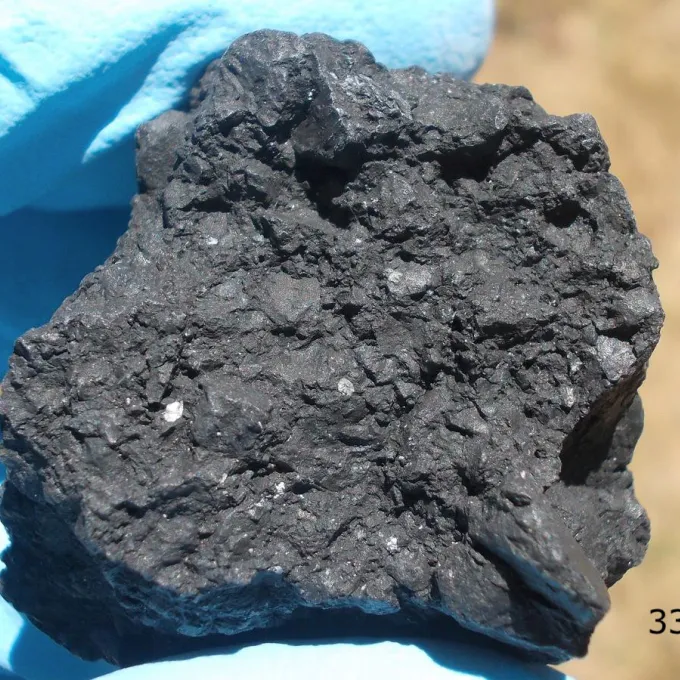
The new system complements existing instruments in the lab, including two mass spectrometers used for elemental and isotopic analysis, meaning they measure both the elements present and subtle variations among them. While those tools remain essential, they rely on dissolving samples. The lab has used them to study lunar materials through NASA’s Apollo Next Generation Sample Analysis (ANGSA) program and samples returned from the asteroid Bennu. The laser can now analyze individual mineral grains directly.

This capability is especially important for complex materials such as lunar breccia, rocks made up of fragments fused together by repeated impacts over billions of years.
“The Moon has been bombarded by space rocks, so many samples are mixtures. Now we can target tiny, pure mineral phases within them,” Wang said, referring to distinct minerals within those mixed samples.
This precision supports Wang’s work using rubidium-strontium dating, a method that compares the decay of one element into another to determine age and refine the timeline of the Moon's formation and evolution. It also positions WashU to help analyze samples returned by NASA’s Artemis missions, strengthening its case for selection as a site for future lunar sample analysis.
A Tool for Multiple Disciplines
David Fike, chair of Earth, environmental, and planetary sciences and an MCSS fellow, is using the system to study sulfur isotopes in marine sediments. His work focuses on reconstructing ancient climate conditions, often using minerals such as pyrite.

“This allows for small-scale elemental and isotopic analysis,” Fike said. “It complements secondary ion mass spectrometry (SIMS), a technique used for very high-resolution analysis. The spatial resolution is not as high, but it is faster, more precise, and less sensitive to matrix effects, meaning the results are less influenced by differences in the material.”
The system is also valuable for meteorite research and for distinguishing between volcanic and impact-generated materials. Sulfur measurements, for example, can help identify whether glass formed from volcanic activity or from an impact event.
For Mike Krawczynski, an MCSS fellow and associate professor of Earth, environmental, and planetary sciences, the laser opens new possibilities. His research focuses on volcanic processes and magma evolution.
“It’s a dream tool,” he said, because it allows researchers to measure trace and major elements simultaneously and quickly identify patterns for further investigation.
In practice, the laser helps researchers identify targets of interest before using higher-resolution techniques such as SIMS. Once they know what to look for, they can focus those tools more effectively.
Already Driving New Research
Even in its early stages, the laser is shaping future work. Researchers are developing three NASA proposals that rely on the capabilities of the new system, supported in part by funds from the McDonnell Center.
In the lab, graduate student Xuanyu Liu operated the system at a workstation, moving between high-resolution images and data outputs on dual monitors.
The system is still being fine-tuned. A service visit to align the instrument is scheduled, followed by a demonstration for a prospective customer, underscoring WashU’s role in introducing the technology to other laboratories.
Looking Ahead
Femtosecond laser systems are complex and still relatively rare. Their advantages in speed, precision, and minimal sample destruction are quickly making them essential tools in geochemistry and planetary science.
At WashU, that future is already taking shape.
With the IRIDIA system now in operation, researchers can probe planetary materials at unprecedented scales, uncover new details about Earth’s history, and prepare for the next generation of lunar exploration.
In a field where geologic samples are often irreplaceable, the ability to learn more while preserving more of the material marks a significant step forward.