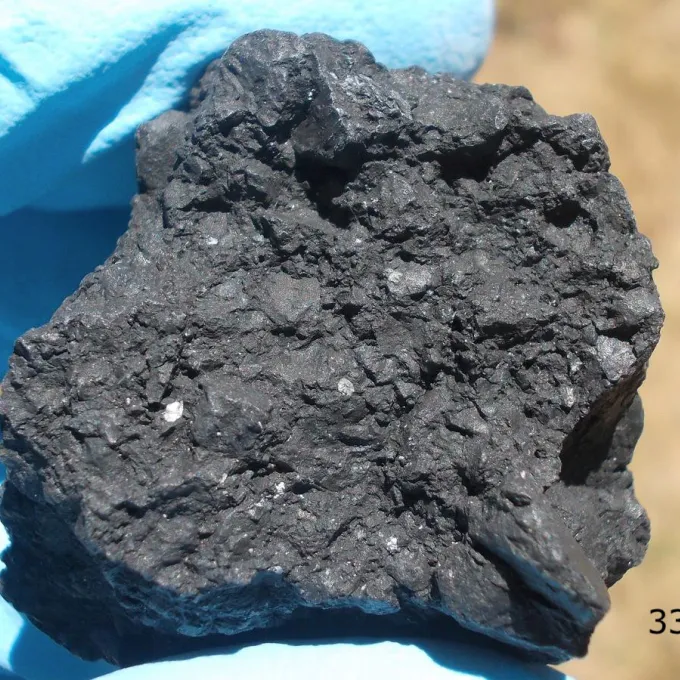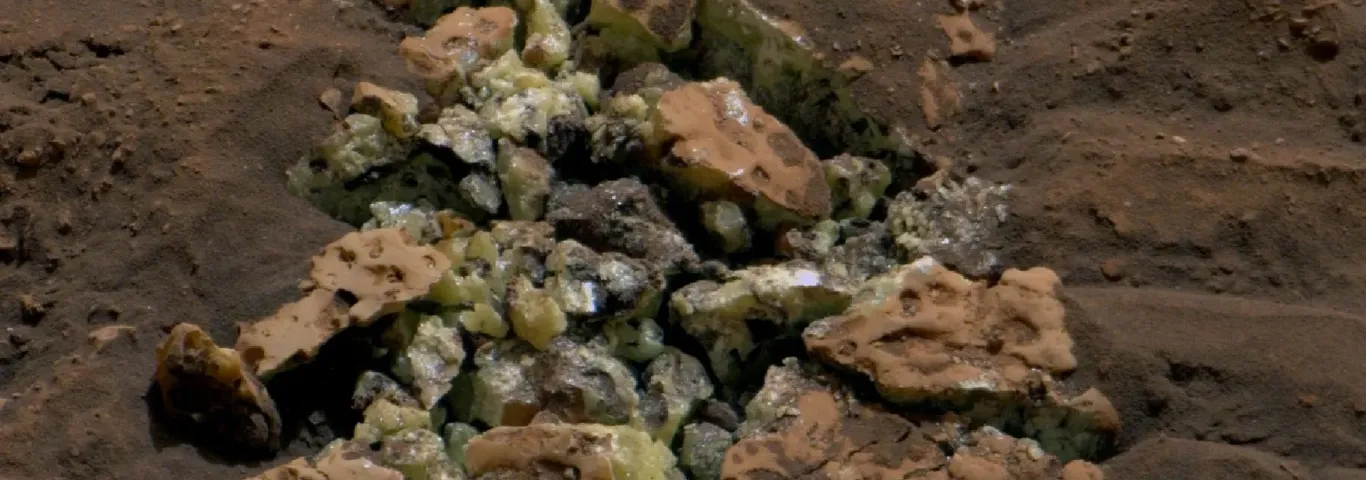

In 2024, the Curiosity Mars rover came across an unexpected sight: a large field of light-colored, fist-sized stones. Readings from the rover’s X-ray spectrometer showed that the rocks were pure, or “native,” sulfur, a surprising first-of-its-kind discovery.
“These sulfur stones formed roughly 3 billion years ago,” said Scott VanBommel, a research assistant professor of Earth, environmental, and planetary sciences and a fellow of the McDonnell Center for the Space Sciences. “It’s a remarkable find.”
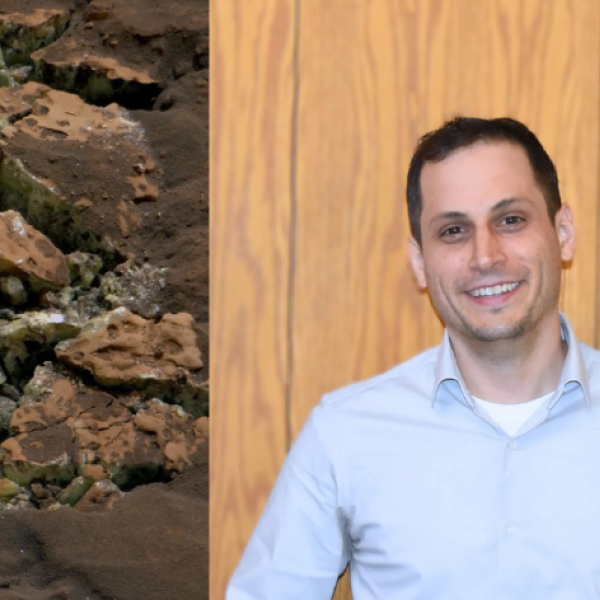
The discovery of pure Martian sulfur was the cover story in the Aug. 20 issue of Science. VanBommel co-led the study with Jeff Berger, a geochemist based at Johnson Space Center in Houston. VanBommel stresses that the work was a team effort, dating back to the design of the now-teenaged Curiosity rover before its launch in 2011. Co-authors on the study included EEPS staff scientist Abigail Knight and EEPS postdoctoral researcher John Christian.
Previous rover missions, such as Spirit and Opportunity, had already shown that sulfates were plentiful in the Martian landscape. As Berger explained, sulfur accounts for about 5 percent of the surface, making it orders of magnitude more abundant on the surface of Mars than on Earth.
Still, the discovery of pure sulfur was a surprise that raised new questions. “It’s hard to wrap your head around how long those rocks had been sitting there with little to no chemical alteration happening to them,” Berger said.
The pure-sulfur stones were discovered in Gale crater, a large indentation caused by a collision with a large meteorite 3.8 to 3.5 billion years ago.
As VanBommel, Berger, and their co-authors explain in the paper, the native sulfur in the crater likely formed when magma beneath the Martian surface released hydrogen sulfide and sulfur dioxide gases. In chemical reactions likely involving water, the gases reacted to form pure sulfur with water as a byproduct.
The sulfur rocks were so pristine that they almost certainly formed where they were found, VanBommel said. “If they had been transported from elsewhere, they would have had entrained debris or been broken into tiny pieces,” he said. VanBommel noted that Curiosity, which weighs less than 750 pounds in Martian gravity, easily crushed sulfur chunks as it traversed across the rim of the deposit.
Pure sulfur exists on Earth, but it is generally associated with either high-temperature processes, such as fumaroles, or microbial activity, VanBommel explained.

The deposit of pure sulfur rocks on Mars almost certainly has a unique origin story. “There’s limited evidence to ambiguous evidence for high-temperature processes in Gale crater, and none in the vicinity of the deposit,” VanBommel said. “We also do not see any evidence that ancient microbes played any role in the formation of these stones.”
The purity of the sulfur speaks volumes about the environmental conditions on this part of Mars, Berger explained. If the sulfur had been exposed to even small amounts of oxygen in the Martian atmosphere after the stones were formed, there would have been signs of oxidation.
The presence of native sulfur also demonstrates that the deposit did not experience long periods of contact with liquid water after formation, VanBommel said. “There is an abundance of evidence that ancient Mars was once hydrologically active, but the 3 billion-year-old chunks of pure sulfur demonstrate a high degree of aridity at least in the location of the deposit since formation.”
Curiosity’s mission is far from over. VanBommel recently received a NASA grant to improve the sensitivity of the rover’s instruments as it explores Mount Sharp, a mountain rising from the center of Gale crater where the pure sulfur stones were discovered. The grant included a dedicated study on using X-ray fluorescence and X-ray scattering to characterize different oxidation states of sulfur in data acquired by Curiosity’s X-ray spectrometer, the exact methodology that enabled the new discovery.
“Mars provides us with a frozen snapshot from billions of years ago,” Berger said. “We can go back and look at deep time in a way that we can’t do on Earth. What the Curiosity rover and team have accomplished since landing in August of 2012 is truly remarkable.”