For decades, methane on Mars has puzzled planetary scientists. Because methane can be produced by geological processes or by living organisms on Earth, understanding where it comes from and where it goes has become one of the most important questions in Mars exploration.
Methane has been detected on Mars by orbiters, rovers, and Earth-based telescopes. Yet observations from different spacecraft and telescopes have presented scientists with a confusing picture. Some observations have revealed sudden spikes of methane that disappear quickly, while others have found little or no methane at all.
The mystery lies in methane's expected lifetime in the Martian atmosphere. Sunlight-driven photochemical reactions can destroy methane, but only slowly, allowing methane generated by geological or other processes to persist for roughly 300 years. Yet observations of spike-like methane concentrations suggest that methane is being removed hundreds to thousands of times faster than photochemistry alone can explain.
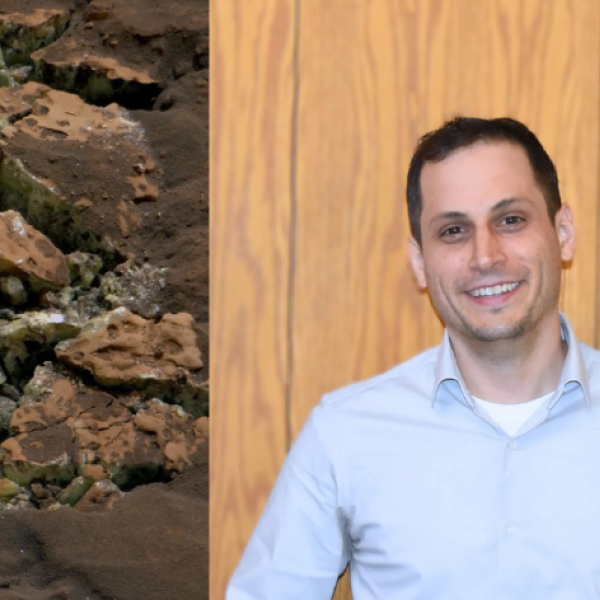
A new study led by planetary scientist Alian Wang, research professor of Earth, environmental, and planetary sciences at Washington University in St. Louis and a fellow of the university's McDonnell Center for the Space Sciences, provides experimental evidence for a possible answer.
Published in Earth and Planetary Science Letters, the study demonstrates that electrostatic discharges generated during Martian dust activity could rapidly break down methane, potentially making dust storms and dust devils a major "scavenger" of methane on Mars.
A Different Way to Destroy Methane
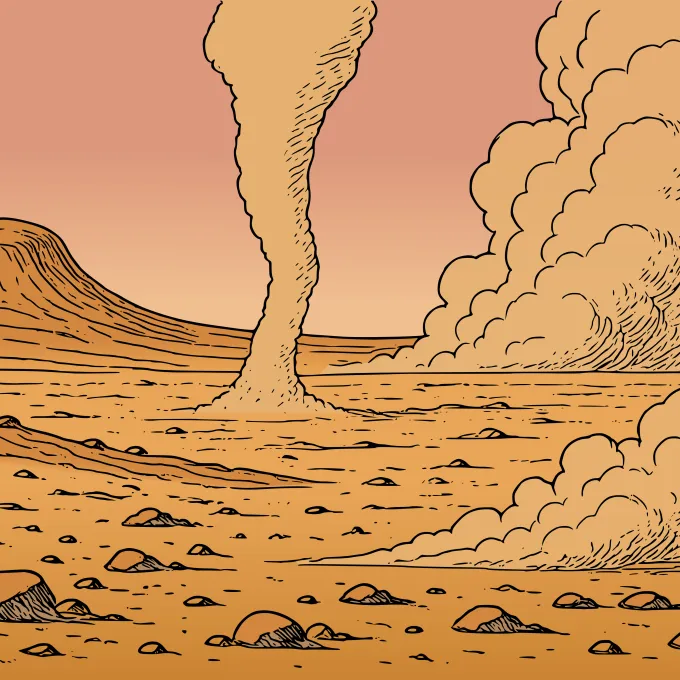
Previous studies have focused primarily on photochemistry, the chemical reactions driven by sunlight, to explain methane's destruction. Wang's team investigated whether Martian dust activity could provide a much faster mechanism for destroying methane. Because Mars is an exceptionally dusty planet, dust grains collide and rub together during dust storms and dust devils, becoming electrically charged.
Under Mars' thin atmosphere, which is less than 1% as dense as Earth's, the electrical fields created by those charges collapse more readily than they do on Earth, producing electrostatic discharges (ESDs) similar to small electrical sparks. These discharges generate highly reactive free radicals, which drive a process known as heterogeneous electrochemistry (HEC) that rapidly breaks down methane.
Earlier work by Wang's laboratory showed that these discharges can trigger a wide range of chemical reactions in the Martian atmosphere and on the planet's surface, shaping the planet's geochemistry. In this new study, the team asked whether the same electrochemical processes could also affect the life cycle of methane.

Recreating Mars in the Laboratory
To test their hypothesis, the researchers recreated conditions similar to the Martian near-surface atmosphere using SCHILGAR (Simulation Chamber with InLine Gas AnalyzeR), a planetary simulation chamber built by Wang's team.
Inside the chamber, they exposed mixtures of carbon dioxide and methane to controlled electrostatic discharges comparable to those expected during mid-strength Martian dust activity. The researchers then used multiple analytical techniques to track what happened as methane molecules broke apart and to measure the rate of methane destruction.
The experiments revealed that electrostatic discharges generated highly reactive free radicals capable of rapidly decomposing methane. As methane broke down, the researchers detected the formation of new hydrocarbon gases, water, and carbon-rich solid deposits composed of complex hydrocarbon polymer-like materials.

From Minutes in the Lab to Mars
Under the team's laboratory conditions, methane had a measured half-life of just under 20 minutes.
Using newly reported observations of electrical activity detected by NASA's Perseverance rover during a Martian dust devil, the researchers made a conservative estimate of how frequently electrostatic discharges occur during dust devils and what that could mean for methane's lifetime on Mars.
Although the estimate contains large uncertainties because very few direct measurements of the electrical properties of Martian dust activity have ever been made, the results suggest that dust-driven HEC could destroy methane hundreds to thousands of times faster than photochemistry alone.
Rather than replacing photochemistry, dust-driven HEC could provide the previously missing mechanism needed to explain why methane plumes disappear so quickly after they are detected.
Solving One Mystery, Opening Another

The study represents the first step in a broader investigation of methane's life cycle on Mars.
While the current study focuses on methane destruction, Wang and her collaborators are already exploring another intriguing possibility. Future studies will also investigate how Martian surface minerals influence these reactions and whether the same electrochemical processes could contribute to methane production.
Future Mars missions capable of directly measuring the electrical properties of dust storms and dust devils could provide the observations needed to test these ideas and determine how much Mars' ever-present dust shapes the chemistry of the Red Planet.
"Methane on Mars is one of the most scientifically significant topics in planetary science, and it has captured scientists' imaginations," Wang said. "The mechanisms responsible for its generation and destruction have been investigated and debated for more than two decades. Because Martian dust activity has been widespread and persistent throughout the Amazonian period, our experimental results provide strong evidence that helps fill an important gap in the complex story of methane on Mars."