
High Energy Horrors: Astronomy on Tap
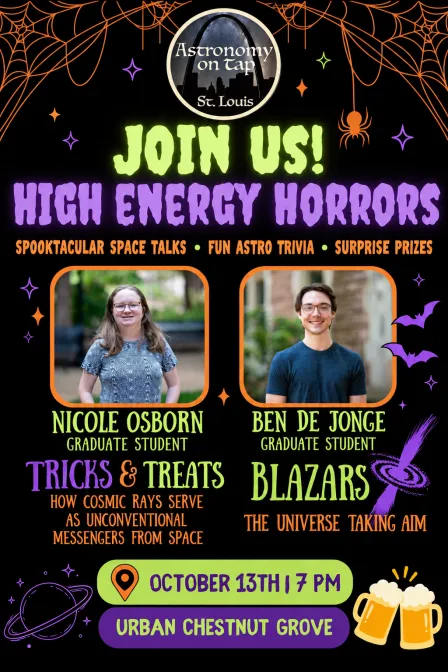
Nicole Osborn — Tricks & Treats: How Cosmic Rays Serve as Unconventional Messengers from Space
Cosmic radiation is composed of charged particles that come from many sources like our sun at a local scale all the way to exploding stars and black holes in our Galaxy and beyond. While many astrophysicists consider cosmic-ray signals as background to their observations and cosmic radiation is a barrier in human space exploration, these charged particles are a useful tool in learning more about space from our local environment around the Earth and Sun to the most energetic events in our Universe like exploding stars and black holes.
Ben de Jonge — Blazars: The Universe Taking Aim
Some black holes are called “supermassive,” meaning they have masses millions to billions times the mass of our Sun. While the black hole doesn’t produce light we can see with our telescopes (since they are, well, ‘black'), they can suck in the material around it which can glow and produce observable light. In the process of consuming material, some black holes produce objects called relativistic jets. These jets are interesting, dynamic, and very large-scale structures in the universe, with the longest jets being much longer than the diameter of our Milky Way. In this talk, I'll describe relativistic jets and define a blazar, a type of supermassive black hole with a jet pointing right at us, using them to illustrate some interesting special relativistic effects.
Join Astronomy on Tap for an evening of science, beer, and cosmic fun, featuring spooktacular space talks, astro trivia, and surprise prizes. The event is open to the public and free, so bring friends, grab a beer, and enjoy some spooky space science!