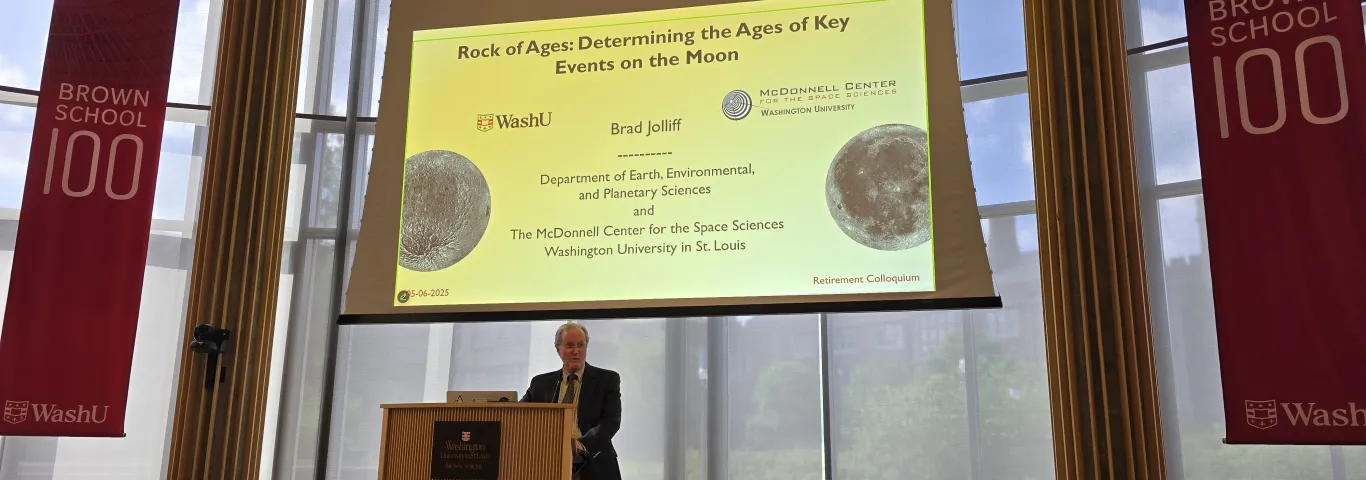
EEPS Colloquium

"Professor Jolliff giving lecture"

Colloquium Lectures

The Department of Earth, Environmental, and Planetary Sciences hosts a weekly colloquium series during the Spring and Fall academic semesters. The series features scholarly talks by scientists from within and outside the university which promote ongoing research, and foster academic discussion.

The lectures generally take place on Thursdays during the academic year at 11:30 AM in Rudolph Hall, Room 301. Light refreshments are served beginning at 11:15 AM. Please check our department events page for the most up-to-date schedule and timing. 

EEPS Colloquia are made possible by the William C. Ferguson Fund.

Fall 2026 EEPS Colloquium Schedule

WUSTL Shield, decorative

Assistant Professor Claire Masteller, Washington University EEPS

Talk Title TBD

Professor Bob Anderson

The life cycle of rock glaciers

Rock glaciers are moving bodies of ice that are sufficiently covered in rocky debris to prevent any significant melt of their ice-rich cores. They are plentiful beneath tall headwalls in our mountains in the West, and constitute the largest manifestation of the modern cryosphere. Compared to their bright true glacier cousins, they are thin, stubby, slow and gnarly. Yet they cry out to be understood as we climb, mine, and photograph among them. I will describe research on three rock glaciers in Colorado’s mountains. We have constrained modern speeds using feature tracking, GNSS and RTK-GPS, and long-term speeds using 10Be in surface rocks. They are moving at speeds of typically 0.5 m/yr but up to 2 m/year in steep places. The landscape appears to have converted from true glacier to rock glacier domination after the Younger Dryas ~ 11 ka. The rock glaciers have been active over the Holocene and continue to advance down their valleys. Their health is governed by significant rockfall and snow avalanching to feed the “rooting zone” beneath the tall rock walls at the heads of the valleys. Numerical models that honor the birth of rock glaciers with sufficient caps of debris in the rooting zone, and subsequent motion of the ice by internal deformation can reproduce both modern and long-term displacement fields only when accommodating significant variation in the supply of avalanched snow over the Holocene.

Professor Suzanne Anderson

Can rock glaciers replace glacier water resources?

Rock glaciers are often cited as a water resource in alpine watersheds, yet their hydrologic behavior is understudied. These debris-mantled ice tongues number in the thousands across the western US, while numbers of true ice glaciers are declining. Can rock glaciers replace the water resources of glaciers? Specifically, does melt of the ice core of the rock generate significant streamflow, and how do rock glaciers affect water flow paths and groundwater recharge? We examine these questions in Imogene Basin, San Juan Mountains, Colorado. We have been sampling the outlet of a rock glacier, groundwater emerging from a mine adit, and nearby alpine surface streams. We combine stream gaging with measurements of water stable isotopes, specific conductivity, water temperature, and 14C ages of dissolved inorganic carbon to partition water sources over time. Multiple lines of evidence show that rock glacier ice does not contribute to runoff in the present climate. I will walk through hydrograph separation, streamflow temperatures, and water mass balance arguments to support this conclusion. The rock glacier does divert infiltrating snowmelt and rainwater through its rocky carapace to its margin, and so is efficient at generating runoff. At the same time, it is probably a barrier to groundwater recharge over its area. Nonetheless, radiocarbon water ages imply that base flow from the rock glacier and from all streams we sampled is dominated by groundwater with hundreds to thousands of years residence time in this alpine basin. Although the rock glacier stores ice, at present it acts as a permeability barrier that steers infiltrating snowmelt and rain through its rocky cover rather than as a water source.

Associate Professor Yuanzhi Tang, Georgia Institute of Technology

Talk Title TBD

Assistant Professor Meghana Ranganathan, University of Chicago

Talk Title TBD

Assistant Professor Bidong Zhang, Rice University

Talk Title TBD